Facility managers, healthcare operators, senior living administrators, hotel owners and property managers all deal with the same basic challenge: indoor spaces need to smell clean, feel comfortable and stay operational. The problem is that many odor and indoor air concerns are hard to explain because the process is invisible. You can smell the problem, but you cannot always see what is happening in the air or on exposed surfaces.
That is why a simple visual demonstration can be so useful.
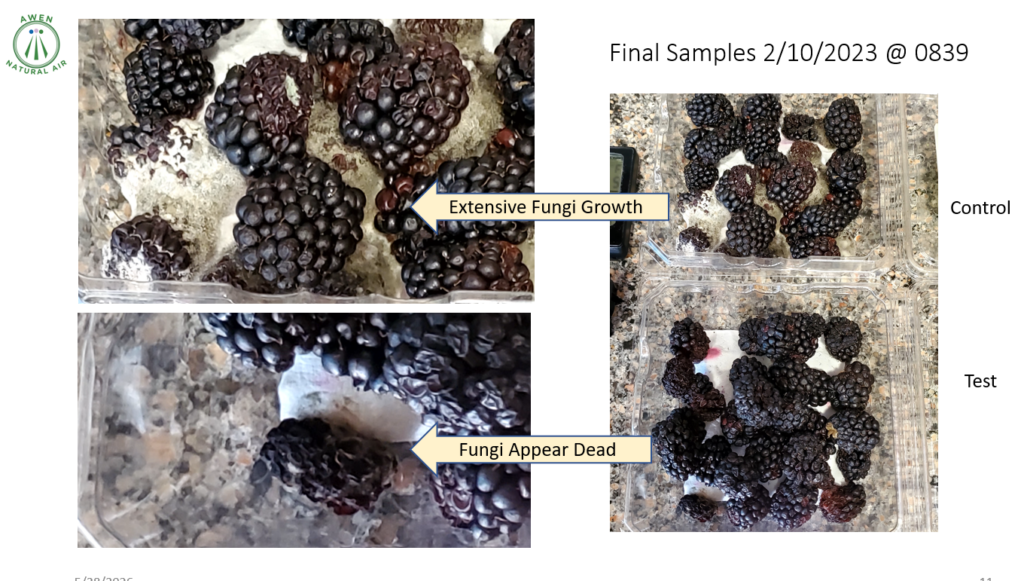
Awen Natural Air recently published a natural air purification case study in Melbourne FL using two clamshells of Driscoll’s organic blackberries purchased side by side from a Publix refrigerated display case in Satellite Beach, Florida. One sample was used as an untreated control. The other sample was placed in a separate area where photohydrolytic equipment generated atmospheric hydroxyl radicals continuously during the test period.
The goal was not to create a laboratory-grade clinical study. It was a low-cost proof-of-concept demonstration designed to see whether exposure to photohydrolytic atmospheric hydroxyl radicals could help improve shelf life by reducing the initiation and spread of fungi. For facility decision-makers, the value is not that a blackberry container is the same as a building. The value is that the demonstration makes an invisible treatment process easier to understand.
Why a Visual Proof-of-Concept Matters
Most people have heard about air purifiers, filters, ozone machines, sprays and odor neutralizers. The trouble is that these solutions are not all designed to work the same way. Some capture particles. Some cover up smells. Some require the space to be empty. Some are better suited for short-term treatment after hours.
Hydroxyl technology is different because it is designed for continuous treatment. Awen Natural Air works with Pyure® hydroxyl radical generator equipment for facility teams that need practical options for odor-sensitive spaces. The equipment is designed to help create oxidants similar to those found naturally outdoors, giving managers another way to think about treatment beyond fragrances, passive filtration or ozone shock treatment.
That sounds promising, but it can also sound technical. The Blackberry Test gives people something they can actually see.
In Awen’s case study, both blackberry samples showed no visible fungi at the start. The first visible fungi in the control sample appeared after approximately six days. The first visible fungi in the hydroxyl-exposed sample appeared after approximately seven days, which was 25 hours and 52 minutes later than the control sample. By the end of the observation period, the control sample showed extensive visible fungi growth, while the hydroxyl-exposed sample showed much more limited visible activity and did not show the same spread across the berries.
The full timeline, images and explanation are available on the Blackberry Test case study page.
The Real Issue Is Not the Blackberries
For a building owner or operator, the real question is not about fruit. The real question is whether an odor treatment or air purification system can help support a better indoor environment while the building remains in use.
That is especially important in facilities that cannot simply shut down every time there is an odor issue. Senior living communities still have residents, visitors and staff in the building. Clinics still have patients. Hotels still need rooms, lobbies, laundry areas and fitness spaces ready for guests. Property managers still need apartments, offices and common areas to feel clean and professional.
The Blackberry Test does not prove that every building will respond the same way. It does, however, give facility teams a simple starting point for understanding how continuous natural air treatment may support a cleaner, fresher indoor environment when paired with the right equipment plan.
Why Odors Are So Hard to Solve in Real Buildings
Odors are frustrating because they rarely stay in one neat location. They can move through hallways, settle into soft materials, return after cleaning or spread through high-use areas. A room may look clean but still smell off. That creates a problem for facility teams because odor affects how people judge the entire space.
In a senior care community, odor can affect the way families feel when they walk in the door. In a clinic, it can affect patient confidence. In a hotel, it can lead to complaints and room changes. In a managed property, it can affect leasing, renewals and tenant satisfaction.
Traditional cleaning is still important, but cleaning alone may not be enough for persistent odor concerns. Sprays and fragrances can make things worse by adding another smell. Ozone can require the area to be empty and is not appropriate for occupied spaces. Filters can help with particles, but they only treat air that passes through the unit or HVAC system.
Hydroxyl technology is useful because it works differently. It is an active treatment method, not just a passive filter or masking agent.
How This Applies to Brevard County Facilities
Facilities in Melbourne, Palm Bay, Viera, Cocoa Beach, Titusville and throughout Brevard County face a wide range of indoor odor challenges. Some are temporary. Some are recurring. Some happen in a single room. Others affect common areas or whole sections of a building.
The best solution depends on the space, the source of the odor, the size of the area, how the room is used and whether the building needs to remain occupied during treatment.
Senior living facilities often deal with odor concerns in resident rooms, common areas, laundry spaces and offices. Hydroxyl equipment can support a fresher environment without relying on fragrances or shutting down occupied areas.
Healthcare and clinics may need help with odors in waiting rooms, treatment-adjacent areas, restrooms and staff spaces. Continuous treatment can help the building feel more professional while normal operations continue.
Hotels and hospitality properties are especially sensitive to guest room odors, lobby concerns, fitness areas and laundry spaces. Portable or scalable equipment can help address odor problems that affect guest experience.
Property management teams often face odor issues during apartment turnovers, office use, lobby operations and shared-space maintenance. Hydroxyl equipment can be used for short-term odor treatment or ongoing support in problem areas.
Food-related facilities may have odor concerns in storage-adjacent areas, packaging spaces and back-of-house areas. A natural treatment approach may help improve the indoor environment without masking smells.
A proof-of-concept like the Blackberry Test helps open the conversation. It gives decision-makers a simple visual example before they get into equipment sizing, placement and operating time.
A Practical Alternative to Sprays, Fragrances and Ozone
Awen Natural Air focuses on natural air treatment using Pyure® hydroxyl technology. The purpose is not to perfume the space. The purpose is to help address odor-causing conditions more directly.
That is an important difference. If a facility is dealing with a recurring odor problem, adding fragrance may only cover the issue for a short time. In some settings, added fragrance can also bother residents, patients, guests or staff. Ozone is another common option, but it is not used around people and can disrupt operations because the treated space needs to be vacant.
Hydroxyl equipment gives facility teams another option because it is designed for occupied-space treatment when selected and used properly. It also does not require the same type of vacancy period associated with ozone treatment.
For busy facilities, that is often the deciding factor. A technology that works only when the building is empty may not be realistic. A technology that can run quietly in the background is much easier to integrate into daily operations.
Portable, Scalable and Easy to Discuss
One of the advantages of working with Awen Natural Air is that the conversation does not have to start with a major purchase. Some facilities may want to rent equipment for a specific odor problem. Others may want to try portable equipment in one area before expanding. Larger buildings may eventually need a more complete equipment plan.
This start-small approach is helpful for managers who need to prove value before making a bigger commitment. It also allows the team to see how the equipment performs in their own space.
Awen can help facility teams think through practical questions such as which areas need treatment first, how long equipment should run, whether a rental or purchase makes more sense and how servicing should be handled.
Start by asking where the odor concern is strongest. Equipment placement should begin with the areas that affect residents, guests, patients, tenants or staff the most.
Next, decide whether this is a one-time problem or a recurring issue. A short-term rental may make sense for a temporary odor, while purchase may be better for ongoing needs.
Then consider whether the space needs to stay occupied. Occupied-space use is one of the main reasons facilities consider hydroxyl equipment.
The size and layout of the treatment area also matter. A single room, a hallway, a lobby and a larger common area may each need a different approach.
Finally, think about who needs to approve the decision. Facility managers, owners, administrators and department heads may all need a clear explanation before moving forward.
This is where the Blackberry Test becomes useful. It gives the decision-maker a simple starting point before moving into the details of the facility.
Read the Full Blackberry Test Case Study
If you want to see the actual demonstration, review Awen Natural Air’s full Natural Air Purification Case Study in Melbourne FL: The Blackberry Test.
The case study shows the visual comparison, the observation timeline and the main takeaway from the side-by-side test. It is a practical proof-of-concept, not a guarantee that every space will respond the same way. Real-world results can depend on the source of the concern, room layout, airflow, humidity, equipment selection and operating conditions.
That is exactly why Awen recommends discussing the specific facility before choosing equipment.
Why Awen Natural Air Is a Smart Choice for Facility Odor Treatment
Awen Natural Air serves Melbourne, FL and Brevard County with Pyure® hydroxyl radical generator equipment rentals, sales and servicing. The technology is well suited for facility teams that want a natural and practical way to treat odors without relying on perfumes, harsh chemicals or ozone shock treatment.
For more background on the equipment, visit Awen’s Technology page. For commercial applications, visit the Commercial Air Purification Solutions page. You can also view other examples on the Case Studies and Testimonials page.
Need Help With Odors in a Facility or Commercial Space?
If you manage a senior living facility, clinic, hotel, office, property management portfolio or other odor-sensitive building in Melbourne or Brevard County, Awen Natural Air can help you decide whether Pyure® hydroxyl equipment is a good fit.
Call (321) 773-3356 or visit awennatural.com to discuss rentals, equipment sales or servicing for your facility.
Awen Natural Air
Melbourne, FL 32901
(321) 773-3356